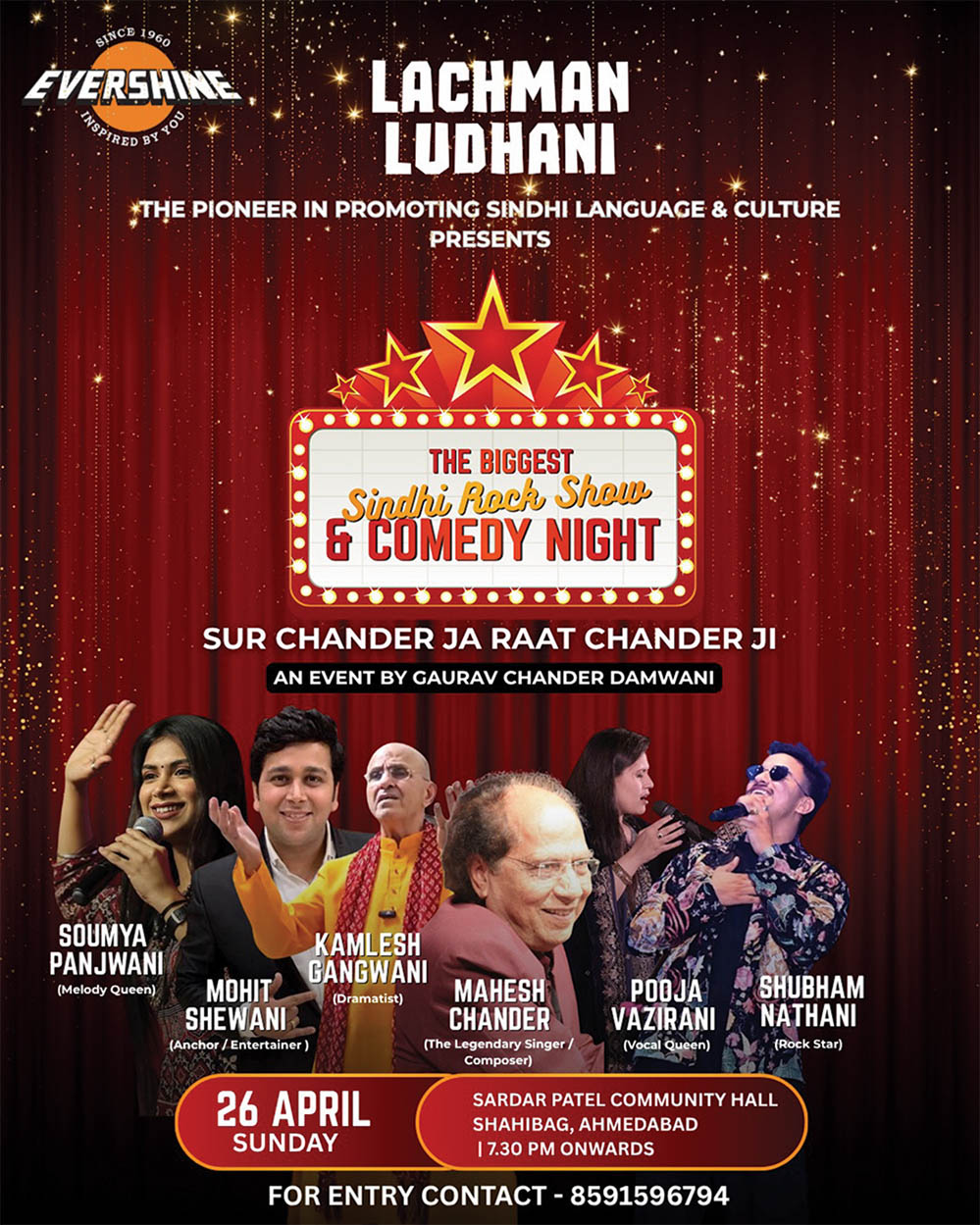
The Biggest Sindhi Rock Show & Comedy Night
AN EVENT BY GAURAV CHANDER DAMWANI
Rocking Performances by
26 April 2026, Sunday 7:30pm onwards at
Sardar Patel Community Hall, Shahbag, Ahmedabad
Sangeet Acharya Master Chander, also known as the Legend of Sindh was born on December 12, 1907 in the town of Tharushah, Sind. He hailed from a merchant and land owner family. As a child, Master Chander was very fond of music, however, since music was looked down upon in those days, he studied music secretly. But, he was encouraged to study music by his uncle, who also bought him his first harmonium from Calcutta, now known Kolkatta. He started singing at sufi shrines at the age of 12 years and, therefore and because he was very young, people started calling him
MASTER CHANDER
One day, Bhagat Kanwar Ram, a great singer of folk music, himself, saw Master Chander perform and predicted that he would become a great singer in the future. He said that Chander will shine like the moon. It's said when Master Chander performed, people would throw money, gold and other valuables on stage in appreciation and acknowledging the power of music.
Like many famous singers of today, who venture into movies, so did Master Chander in the late 1930s. He worked in films including "Dilaram" and "Maut Ka Toofan", in which he played the hero. He was also supposed to perform lead role in movie "Achoot Kanya" with Devika Rani, then a super star, but was later replaced by AShok Kumar due to tragedy in his family that two of his five sons passed away within months of each other.
He was needed at home and thus it ended his movie career. But, Master Chander did record seven songs for "Achoot Kanya".
Master Chander, recorded his first song and hit "Sunhina Arza Ahe" in 1932. This song became a phenomenon on the radio- the song was unlike any other heard in the early days of radio. It was a mix of classical music and a styleof his own, of what now we can categorize as an early rendition of Rap and R&B. After his first hit, there was no looking back.
Master Chander was not only a singer and actor but also a poet and music director, he composed music for most ofhis popular songs. Among his contemporaries were many other singers such as Jeevni Bhai, Allah Rakhi, Bhagat Motan, Jaro Bhagat, and Sawami Kundan, however, Chander always had his own style and was ahead of the game.
As Poet he authored several books and stories, a few amongst:
Master Chander was more so famous among the younger generations of that time - you can say his fan following and musical hits reached the heights of Elvis Presley and the Beatles. His songs
"Rutha Ee Rahan Perr Hujain Hayati", "Dil Ahey Hathan Mein", "Rana Vahju Na Ute" and "Kabootar Kabootar" as well as many other songs were very popular not only in Sindh, but all over the world.
Beside his own poetry, Chander sang songs written by the great poet Prasram Zia. Master Chander was the only singer in the entire history of MV music who was paid 7% of royalties whereas others were getting 5% orless.
In 1947, during the partition of India, Master Chander and the majority of Sindhis were forced to leave their homes and properties in Sind. He narrowly escaped his own death during those tumultuous days, having sent his family-his pregnant wife, Heti, mother, three sons and three daughters, as well as extended family members ahead in a ship to Bombay, India. Seeing the plight of hispeople and missing his homeland, he began to write and sing songs about giving confidence to the displaced Sindhis in India, some of the notable songs during this period were "Mitha Abana" from the movie Abana with well known Sindhi actors and actress, "Kismat Kai Judai", Maalik toon dard kateende and "Hoshiyar Sindhi"
After the partition, living in Bombay with his growing family, he continued to record music and sing in films. He also vocally trained his sons Gope and Mahesh Chander. Gope Chander, now lives in New York and is a well known singer throughout the United States. Mahesh Chander is also a famous singer, known as the "Man with the Velvet Voice", Mahesh Chander is also a music director, who has won many awards, including being recognized for composing the poetry of Prime Minister, Atal Bihari Vajpayee.
One of the most endearing songs of Master Chander was "Nandri Nandri Ahiyan"- a story of an eight (8) year old girl, her servant - Piral and a thief. It was sung in a story telling style. The song was recognized by Prime Minister Jawaherlal Nehru in the early 1950s.
In 1955, Master Chander was given the rare opportunity to give a concert in Sind, and he did so along with his son Gope Chander. There they were warmly welcomed by the people of Sind and and whole Pakistan. After his return to India, he never visited Sind again, but gave concerts all over the world during the 1960s and early 1970s. In November 1984, the music stopped and Master Chander left behind a lifetime of music, songs and his family, to become
"The Legend of Sind".
In the mid-1990s, in honor of Master Chander, his family created the Master Chander Sangeet Academy in New York, USA and Bombay, now Mumbai, India. Every year in either December or January, a concert in the memory and birth of Master Chander is held in New York, Mumbai, Delhi, Jaipur, Ahmedabad and Ulhasnagar. The music continues with Master Chanders sons- Gope and Mahesh Chander, grandchildren- Arti Raj Chander, Harish Chander and Anil Chander. The music will forever continue with future generations from his family-and beyond.
As Singer & Composer: During his career as Singer for 47 years, H.M.V. Company recorded around 400 Gramophone Records and Cassettes. Other companies like Tips, Movac, IBH bought out his Live Performance cassettes. Unconfirmed report says he Sang over 1000 songs of mix folk, emotion, love and meaningful message. Efforts are on to compile all of his songs in MP3 format for the coming generations. Recognition By Way Of Awards/ Honours: H.M.V. Company awarded Master Chander, several Gold Medals. In addition, the Sindhi Panchayats & dead person - I am fed up of living. He only will die who is alive - I am free from this life and death circle. His legacy is not only limited in his family but well wishers, worldwide fan circle where age is no bar.
1. ‘Chander San Rihaniyun’ (Intimate Interaction with Chander), Poems, 1952.
2. ‘Sacho Sathi’ (True Friend), on his Guru Kaka Jiwatram, 1968.
1. During his career as Singer for 47 years, H.M.V. Company recorded around 400 Gramophone Records and Cassettes. Other companies like Tips, Movac, IBH bought out his Live Performance cassettes.
H.M.V. Company awarded Master Chander, several Gold Medals. In addition, the Sindhi Panchayats & Associations in India & Abroad felicitated him with Medals, Trophies, Shields and other gifts of enduring nature. The last was in 1982 by ‘International Sindhi’ at Birla Matoshri Hall, Mumbai.
Master Chander had a passion for music from his childhood. Born in a Zamindar family, where singing was considered a ‘taboo’. Master Chander faced great odds in acquiring rightful place in the field of music in Sind. He was not only the most popular singer of HMV, but also a legendary figure, who brought new singing wave in Sind. He could truly be called a ‘melody’ that touched the very pulse of man who, was love lorn, distressed & disappointed. His renderings kept the audience spellbound for hours. One of his rendering ‘Rutha Ee Rahan, Para Hujen Hayati’ (Let them live long even when they are not on good terms) was most popular. He had the knack of keeping his audience, spell bound for hours.


